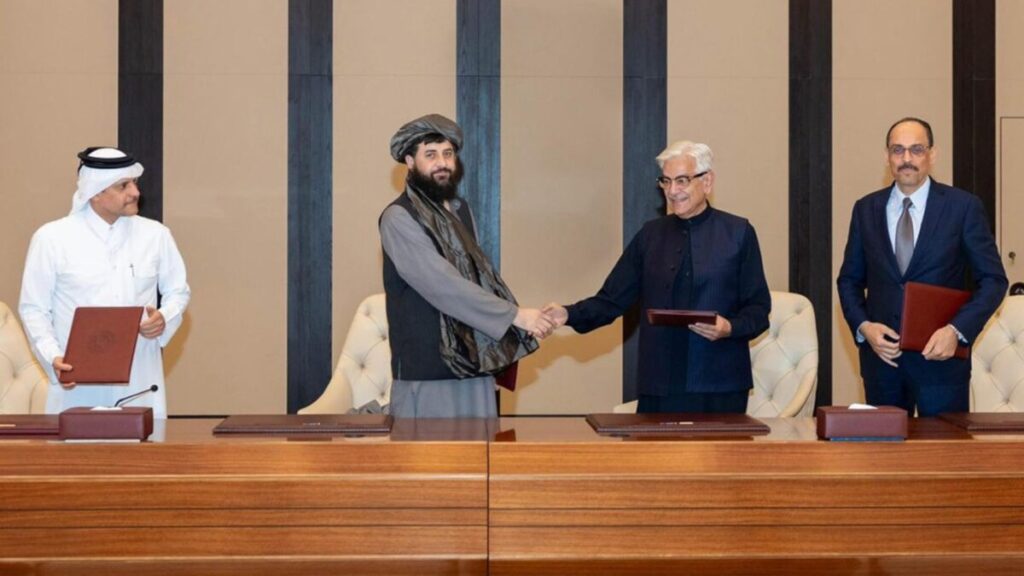
Afghanistan border calm has finally returned to the Durand Line.
A major diplomatic breakthrough has been announced from Doha, where Pakistan and Afghanistan have agreed to an immediate Taliban-Pakistan ceasefire following a week of fierce fighting that left soldiers, civilians, and even cricketers dead in its wake. The smoke may be clearing, but the scars run deep—and the ghosts of Pakistan’s own making are not so easily exorcised.

The talks that have been mediated by Qatar and Turkey brought both sides to the negotiating table after days of escalating violence that threatened to spiral into a full-blown regional conflagration. The resulting deal is aimed not just at ending hostilities, but at setting the stage for long-term stability—a tall order given the decades of betrayal, manipulation, and mutual suspicion that define this relationship.
Now, according to Qatar’s foreign ministry, both nations will now move toward building mechanisms to sustaining peace, and also follow-up meetings that are planned in the coming days to ensure that the Taliban-Pakistan ceasefire actually holds. The Qatar government has expressed hope that this agreement will not only ease the current tensions but will also lay the foundation stone for uh lasting peace in the region. But hope, as history has shown, is not a strategy—especially when dealing with a neighbor that has spent the last forty years playing with fire.
Updates from Pakistan Afghanistan Border Where Tensions Continue to Simmer

Fresh clashes broke out between the two sides at dawn on Wednesday. Afghan officials say at least 15 civilians have been killed and dozens wounded in the latest fighting—a grim reminder that it is always the innocent who pay the heaviest price. Meanwhile, Pakistan’s military said around 20 Taliban fighters were killed in the clashes, though independent verification remains elusive in this fog of war. These were the final spasms before the Taliban-Pakistan ceasefire took hold.
The latest clashes have erupted in the southern Afghan district of Spin Boldak, a region that has seen repeated cross-border shelling in recent years. The Taliban government has accused Pakistani forces of launching fresh attacks with light and heavy weapons in the region, targeting not just military posts but civilian homes. The statement did not mention any Taliban casualties but said calm had returned to the area after Pakistani soldiers were killed and posts and weapons were seized—a sign of tactical reversal. This fragile calm is now enshrined in the Taliban-Pakistan ceasefire.
Clashes also occurred along the border in Pakistan’s Khyber Pakhtunkhwa province on Tuesday, underscoring how fluid and porous this frontier truly is. Pakistan claims a key commander of the Tehreek-e-Taliban Pakistan (TTP) was killed in the operation—a significant claim if true, given the TTP’s role in destabilizing Pakistan itself. However, no such report has been confirmed by the Taliban, who continue to deny harboring anti-Pakistan militants, even as Islamabad insists otherwise. The new Taliban-Pakistan ceasefire seeks to end such accusations.
Meanwhile, a deputy police spokesperson in Afghanistan’s Khost province also confirmed clashes in the region but declined to share further details, a sign of the chaotic information environment that prevails along this contested line. This was the second major confrontation between the two sides this week, a pattern that suggests the violence was not isolated but part of a deliberate escalation. Thankfully, the Taliban-Pakistan ceasefire has now paused this cycle.
Violence Between the Two Neighbors Fled Since Explosions in Afghanistan Last Week
Violence between the two neighbors flared since explosions in Afghanistan last week, including two in Kabul—blasts that shook the capital and sent shockwaves through diplomatic circles. The Taliban says the explosions were a result of air strikes carried out by Pakistan, a claim supported by crater analysis and eyewitness accounts from residential neighborhoods far from any known militant hideout. These strikes nearly derailed prospects for a Taliban-Pakistan ceasefire.

In retaliation, Afghanistan says it launched an operation in at least five provinces along its border with Pakistan, targeting suspected launch pads and infiltration routes. Following this, Islamabad vowed a strong response of its own on Sunday, unleashing artillery and drone strikes that turned border villages into rubble. The intensity of this exchange made a Taliban-Pakistan ceasefire seem impossible—until Doha intervened.
The standoff intensified with border clashes and heavy casualties were reported on both sides. Pakistan claims to have killed over 200 Taliban and affiliated fighters in the strikes—an inflated number, many analysts suspect, given the lack of battlefield access. Afghan Taliban forces claimed to have killed 58 Pakistani soldiers while Pakistan claimed its losses stood at 23, a discrepancy that speaks to the fog of war and the propaganda value of casualty counts. Now, under the Taliban-Pakistan ceasefire, both sides must verify losses transparently.
At the heart of the dispute lies a bitter accusation: Islamabad accuses Afghanistan of harboring the Tehreek-e-Taliban Pakistan (TTP), a group accused of killing hundreds of Pakistani soldiers since 2021. Kabul, however, has repeatedly denied Islamabad’s claims, arguing that Pakistan itself is the source of instability—by backing ISIS-K, the Islamic State’s Khorasan Province, which both the Taliban and Afghan civilians identify as their mortal enemy. Resolving this is key to the Taliban-Pakistan ceasefire.
Amid the Continuing Clashes, Residents in Border Areas Have Been Forced to Flee Their Homes

“This fighting has been going on since early morning, and the people who live close to the border are leaving the area,” said one displaced resident in a voice thick with exhaustion. “These people are coming from Kil Lukman and Bajaur. They are worried. Both countries are requested to stop this war. People are in a very difficult situation. Shells are falling in homes.” Their suffering underscores why the Taliban-Pakistan ceasefire matters.
It is this human dimension—the shattered lives, the uprooted families, the children who have never known peace—that gets lost in the strategic calculus of generals and diplomats. Despite appeals from Saudi Arabia and Qatar to de-escalate tensions, the clashes have continued, as if the suffering of ordinary people means nothing to those who hold the guns. The Taliban-Pakistan ceasefire is their only hope.
Earlier, US President Donald Trump said he was willing to mediate between Pakistan and Afghanistan, calling himself a quote unquote expert at resolving wars and establishing peace—a claim met with skepticism given his administration’s chaotic withdrawal from Afghanistan in 2021. Meanwhile, China urged both sides to exercise restraint and ensure the safety of Chinese personnel, projects, and institutions in the region, a clear reference to its massive investments in the China-Pakistan Economic Corridor (CPEC), which runs perilously close to the Afghan border. Beijing supports the Taliban-Pakistan ceasefire for economic reasons.
Beijing stated that both nations were its friends and neighbors and added that peaceful coexistence and cooperation are in their long-term interests—a diplomatic formulation that masks China’s deep anxiety about spillover militancy threatening its Belt and Road ambitions. Stability hinges on the Taliban-Pakistan ceasefire holding.
The latest border exchange once again underscores the fragile nature of Pakistan-Afghanistan ties where security concerns, militancy and mistrust continue to fuel instability. Both governments are yet to issue an official statement on Wednesday’s confrontation, but the situation along the frontier remains tense, with troops dug in and fingers on triggers. The Taliban-Pakistan ceasefire has lowered those fingers—for now.
A Point Minister Came to India

A prominent minister came to India. His name is Amir Khan Muttaqi, he was in India for a week. It was the first official visit by a Taliban leader to New Delhi, so Pakistan’s paranoia went into overdrive. They fear that India is expanding its influence in Kabul—a fear rooted not in reality, but in decades of self-inflicted strategic blunders. This visit indirectly catalyzed the Taliban-Pakistan ceasefire.
The fact is their border tensions and their problems in general have nothing to do with India. For decades, Pakistan played a double game: they supported America’s war on terror while secretly arming the Taliban next door. The investor logic was this: a friendly Taliban regime would keep India out of Afghanistan. The plan worked for about 5 minutes. Then it backfired. Today, that same friendly regime says Pakistan is a problem. The irony is not lost on architects of the Taliban-Pakistan ceasefire.
Kabul has accused Pakistan of helping ISIS-Khorasan—that Islamic State in this part of the world—they are the Taliban’s sworn enemy. Afghanistan says Pakistan is using the ISK to destabilize their country on purpose. Pakistan has dismissed these claims, but actions speak louder than denials. Trust must be rebuilt for the Taliban-Pakistan ceasefire to endure.
Will it escalate into a full-blown war? It’s unlikely—the Taliban do not have the air power or the hardware to take on Pakistan—but border skirmishes and proxy battles will continue. Neither side trusts the other. And that makes it a bitter reckoning for Pakistan. For years, they exported terrorism to their neighbours. The terror has found its way back home. Only a durable Taliban-Pakistan ceasefire can break this cycle.
So yeah, this is not India’s proxy war. This is Pakistan’s own past coming back to claim its due. The Taliban-Pakistan ceasefire is Pakistan’s chance to reckon with that past.
From one ceasefire to another, this one is at the Afghan front. It was broken just 48 hours ago, but tonight it lies in ruins. A suicide bomber drove into a convoy of Pakistani troops, 7 soldiers are dead. Pakistan has confirmed the attack. It hasn’t named the Taliban yet, but the timing is hard to ignore—coming just days after Muttaqi’s India visit. Such attacks threaten the Taliban-Pakistan ceasefire.
For the last few weeks, both sides traded fire across the Durand Line. The Durand Line is a colonial border, a border that Afghanistan never recognised. Now they’ve been fighting along this border. Kabul says Pakistan hit civilian areas. Islamabad insists it targeted militants—a classic case of denial in the face of overwhelming evidence. The Taliban-Pakistan ceasefire demands accountability.
Last week, it was Pakistan that lit the fuse—it launched airstrikes on Kabul over the weekend, the Taliban hit back, and what followed was a bloody exchange. Pakistan said it killed over 200 Taliban fighters, the Taliban said they killed 58 Pakistani soldiers, and though we cannot verify the claim, we can tell you that the situation remains tense and amid all the smoke and shattered debris, Pakistan is back to its favorite national pastime: naming India. The Taliban-Pakistan ceasefire rejects this scapegoating.
Final Thought
The Taliban-Pakistan ceasefire may have silenced the guns—for now—but true peace demands more than temporary truces. It requires accountability, trust, and a willingness to confront decades of deception. As civilians pick up the pieces and diplomats draft follow-up meetings, one truth remains: Pakistan’s past has come home to roost, and no amount of blaming India can change that.







1 thought on “Breakthrough Taliban-Pakistan Ceasefire Ends 7 Days of Bloodshed—But Can It Last?”